
Best Portable Tire Inflators for Cars in 2026
Five portable tire inflators compared for daily drivers, SUVs, road trips, DIY garages and emergency roadside use. We look beyond maximum PSI to compare power source, portability, tire size, battery use and real-world practicality.
Best Portable Tire Inflators for Cars: Quick Comparison
| Inflator | Power | Max Pressure | Best For | Key Advantage | Main Limitation |
|---|---|---|---|---|---|
| Fanttik X8 APEX | Built-in battery | 150 PSI | Portable car/SUV top-ups | Compact cordless design | Battery-powered runtime |
| DEWALT DCC020IB | 20V / 12V DC / 110V AC | 160 PSI | Garage + roadside use | Three power sources | Battery and charger sold separately |
| Milwaukee M18 2848-20 | M18 battery | 150 PSI | Frequent DIY use | TrueFill + fast inflation | Requires M18 battery ecosystem |
| AstroAI S8 Air | Built-in battery | 150 PSI | Emergency roadside kit | Inflator + jump starter combination | Not a replacement for a heavy-duty compressor |
| VIAIR EVC88P | 12V battery clamps | 120 PSI | SUV, truck and off-road use | Long hose + durable 12V design | Needs direct 12V power |
Specifications are manufacturer-published figures and can vary by model variant or market. Amazon prices are intentionally not hard-coded because they change frequently.
What Actually Matters When Buying a Tire Inflator?
A tire inflator can look impressive on a product page because it says 150 PSI, 160 PSI or even higher. But maximum pressure alone tells you surprisingly little about how useful the machine will be on your car.
For normal passenger-car use, the more important questions are: How quickly does it add air? How long can it run? Does it shut off automatically? How is it powered? Can you reach all four wheels easily? And is it designed for your tire size?
1. Power source
Cordless inflators are convenient because they do not need a vehicle power cable. Larger 12V compressors can provide more sustained operation, while tool-battery models are particularly attractive if you already own batteries from the same system.
2. Airflow
Airflow is often more useful than headline PSI when comparing inflation speed. Larger-volume tires generally need a compressor that can move enough air without spending excessive time running.
3. Duty cycle
A compressor's duty cycle tells you how long it can operate under specified conditions before needing a cooling period. This becomes especially important for SUVs, trucks, off-road tires and multiple vehicles.
4. Auto shutoff
Set-and-forget pressure control is one of the most useful features for everyday drivers. You select the target pressure and the compressor stops when it reaches the programmed value.
1. Fanttik X8 APEX

Fanttik X8 APEX
The Fanttik X8 APEX is aimed at drivers who want a genuinely portable compressor rather than a traditional 12V unit with a long power cable. It is rated to 150 PSI and uses a built-in rechargeable battery.
Fanttik lists 32 L/min airflow for the X8 APEX family, along with automatic shutoff and preset inflation modes. The exact X8 APEX variant matters, so check the Amazon listing before buying.
Check Price on Amazon → Official Fanttik SpecsWhy it stands out
- 150 PSI maximum pressure.
- Portable cordless design.
- Digital pressure display and automatic stop.
- Preset modes simplify routine inflation.
- Useful for cars, SUVs and other compatible applications.
What to watch
- Battery capacity limits how much work you can do between charges.
- Do not confuse maximum PSI with inflation speed.
- Check the exact X8 APEX variant because Fanttik has multiple versions.
- For repeated large-tire work, a larger 12V compressor may be more practical.
2. DEWALT DCC020IB
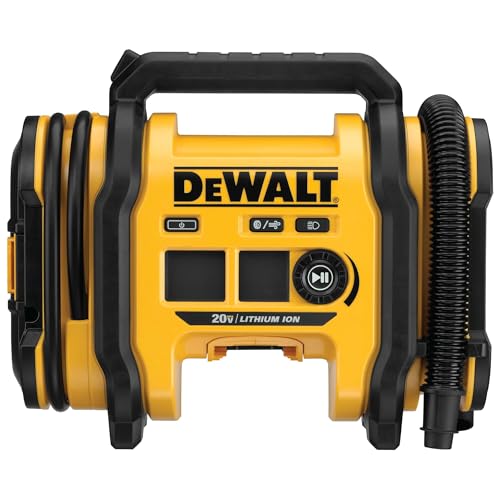
DEWALT DCC020IB 20V MAX Inflator
DEWALT takes a different approach from small rechargeable inflators. The DCC020IB can run from a DEWALT 20V MAX battery, a 12V DC source or 110V AC, giving it much more flexibility around the garage and on the road.
DEWALT lists a 160 PSI maximum pressure, high-pressure inflation with automatic shutoff, plus a separate high-volume mode for items such as mattresses and inflatables.
Check Price on Amazon → Official DEWALT SpecsWhy it stands out
- 20V MAX battery operation.
- 12V DC operation.
- 110V AC operation.
- 160 PSI maximum pressure.
- Automatic shutoff at the selected pressure.
- High-volume inflation and deflation modes.
- Built-in LED light and accessory storage.
What to watch
- This is larger than compact glovebox-style inflators.
- The listed DCC020IB is a tool-only package.
- Battery and charger are sold separately.
- Its biggest advantage is much easier to justify if you already own DEWALT 20V MAX batteries.
3. Milwaukee M18 2848-20
Milwaukee M18 2848-20 Inflator
The Milwaukee M18 inflator is designed more like a serious cordless power tool than a small emergency gadget. Milwaukee rates it to 150 PSI and says it can top off 33-inch light-truck tires in under one minute under its stated test conditions.
Its TrueFill system checks pressure, allows the pressure to stabilize, and continues filling until the selected target is reached. Milwaukee also provides four PSI memory slots.
Check Price on Amazon → Official Milwaukee SpecsWhy it stands out
- 150 PSI maximum pressure.
- Designed for passenger, light-truck and medium-duty tires.
- TrueFill automatic pressure-check technology.
- Automatic shutoff at selected PSI.
- Four PSI memory slots.
- 36-inch hose and brass Schrader chuck.
- Fits Milwaukee M18 batteries.
What to watch
- The M18 battery ecosystem is part of the ownership equation.
- It is much larger than tiny handheld inflators.
- Its strengths matter most for people who use an inflator regularly.
4. AstroAI S8 Air
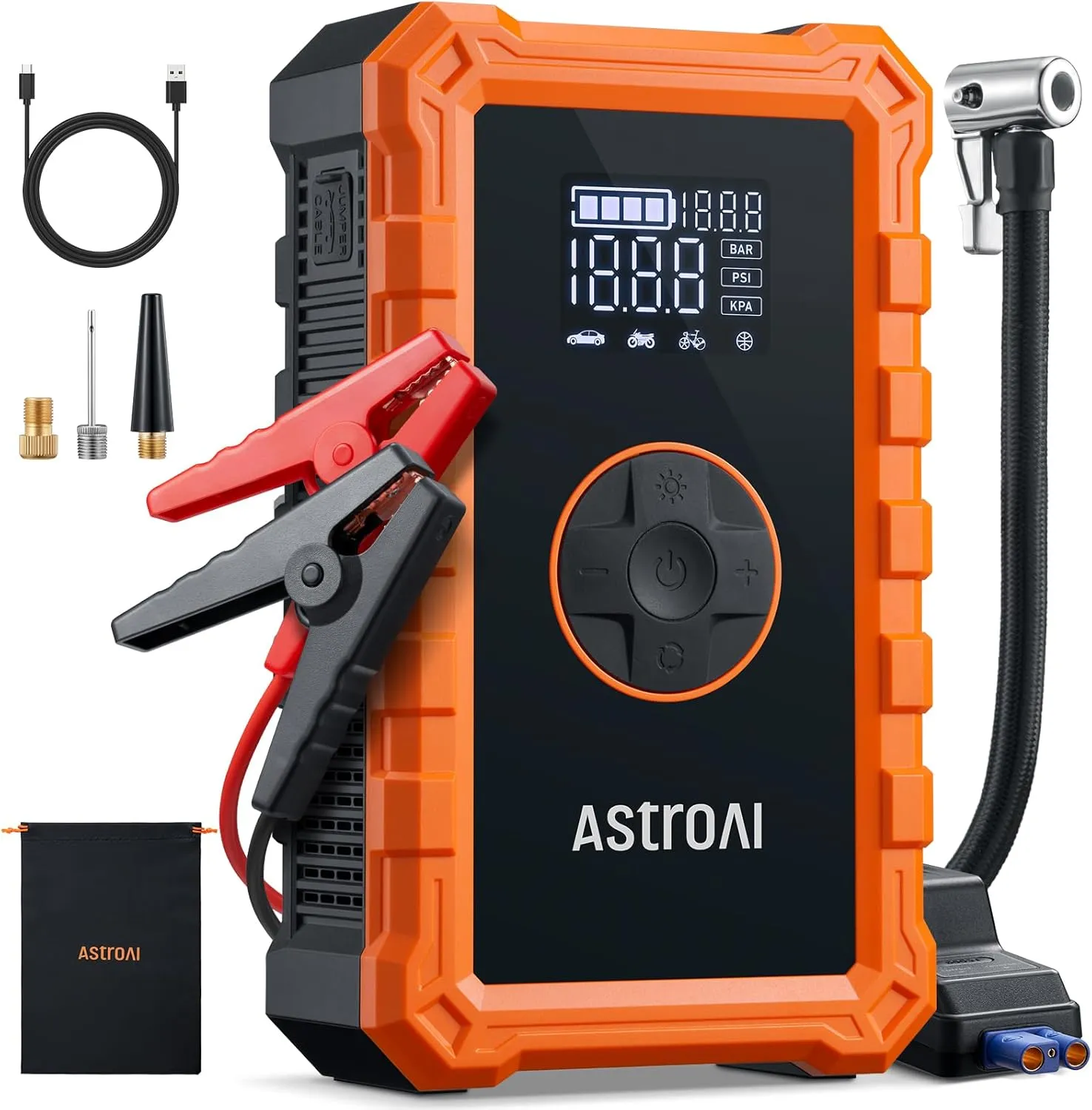
AstroAI S8 Air
The AstroAI S8 Air combines a tire inflator with jump-starting, power-bank and lighting functions. That makes it less of a dedicated compressor and more of a roadside emergency device.
AstroAI lists a 150 PSI tire compressor, a built-in rechargeable battery, automatic tire inflation control and compatibility with passenger cars, motorcycles and other vehicle types within its published limits.
Check Price on Amazon → Official AstroAI SpecsWhy it stands out
- 150 PSI tire inflator.
- Built-in rechargeable battery.
- Jump-start capability.
- Power-bank functionality.
- LED emergency lighting.
- Preset inflation modes and automatic stop.
What to watch
- Its biggest value comes from combining several emergency functions.
- It should not be treated as a substitute for a high-volume compressor.
- Check the published engine and vehicle compatibility before relying on the jump-start function.
- For repeated large-tire inflation, a dedicated compressor may be more suitable.
5. VIAIR EVC88P Digital Portable Compressor
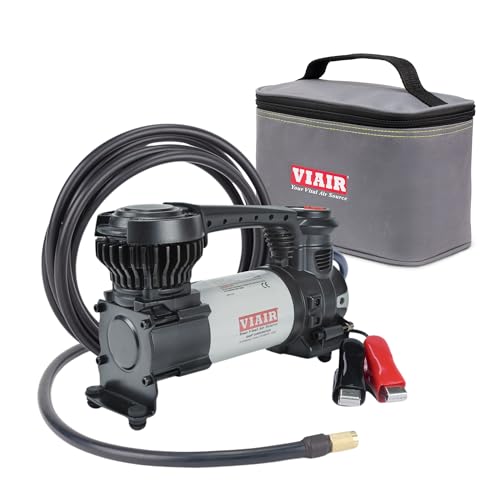
VIAIR EVC88P Digital
VIAIR takes the traditional portable 12V compressor approach and adds a digital pressure display, preset pressure and automatic shutoff. The EVC88P is designed to connect directly to a vehicle battery using its included clamps.
VIAIR lists 1.97 CFM at 0 PSI, 120 PSI maximum working pressure, a 25-minute duty cycle at 30 PSI, a 16-foot air hose and a 4.75-pound net weight.
Check Price on Amazon → Official VIAIR SpecsWhy it stands out
- 12V direct battery operation.
- 1.97 CFM airflow at 0 PSI.
- 120 PSI maximum working pressure.
- 25-minute duty cycle at 30 PSI.
- 16-foot air hose.
- Digital gauge with preset pressure.
- Automatic shutoff.
- LED work light and carry bag.
What to watch
- It is not a cordless internal-battery inflator.
- You need access to the vehicle battery or compatible 7-way connector configuration.
- Check the vehicle's electrical system and power requirements before use.
- The compressor is more substantial than small handheld inflators.
Cordless vs 12V vs Tool-Battery Inflators
| Type | Advantages | Trade-Offs | Good For |
|---|---|---|---|
| Built-in cordless | Very portable, no vehicle cable, easy roadside use | Battery runtime limits repeated inflation | Daily drivers and emergency top-ups |
| Tool-battery | Strong performance and swappable batteries | Battery ecosystem can add cost | DIY mechanics and existing tool owners |
| 12V battery-powered | Longer sustained operation and strong airflow potential | Requires connection to vehicle power | SUVs, trucks and off-road use |
| Multi-power | Most flexible around garage and vehicle | Larger and less glovebox-friendly | Home garage + roadside users |
How Much PSI Do You Actually Need?
This is one of the most common mistakes when shopping for a portable compressor. A 160 PSI compressor is not automatically better for a normal passenger car than a 120 PSI compressor.
Your vehicle manufacturer specifies the recommended cold tire pressure. That information is normally found on the driver's-door or doorjamb tire-information placard and in the owner's manual.
Check Tire Pressure When the Tires Are Cold
Tire pressure changes with temperature and driving. For the most consistent reading, check pressure before driving or after the vehicle has been parked long enough for the tires to cool.
If you discover a low tire during a road trip, adding air can still be appropriate, but do not dramatically adjust the target simply because the tire is warm.
Can a Portable Tire Inflator Fill a Completely Flat Tire?
Sometimes, but this is where expectations matter.
A compressor can add air to a tire that has lost pressure, provided the tire is still properly seated on the wheel and the compressor is capable of doing the job. But an inflator does not repair a puncture, damaged valve or other leak.
Car vs SUV vs Truck: Does Tire Size Matter?
Yes. Tire volume can have a major effect on inflation time. A compact sedan tire and a large SUV or light-truck tire may require very different amounts of air even if their recommended pressures are similar.
Compact / sedan
A small cordless inflator is usually convenient for regular pressure corrections and emergency top-ups.
Crossover / SUV
Look more carefully at airflow, battery capacity and the manufacturer's stated vehicle/tire compatibility.
Pickup / light truck
A stronger tool-battery or 12V compressor becomes more attractive, especially when several tires need air.
Off-road / overlanding
Prioritize duty cycle, airflow, hose length, direct battery power and durability rather than simply choosing the highest PSI number.
What Features Are Actually Worth Paying For?
Automatic Shutoff
This is one of the easiest features to recommend. Set the target pressure, start the compressor and let the machine stop at the programmed value.
Digital Pressure Display
A digital display makes target-pressure setting easier, especially at night. It also reduces the need to carry a separate gauge, although a separate gauge can still be useful for verification.
Long Hose
A long hose is particularly useful on larger vehicles because you can reach all four wheels without constantly repositioning the compressor.
LED Light
A built-in light is a small feature that becomes genuinely useful when a tire goes low after dark.
Battery Capacity
Bigger batteries generally provide more available energy, but they also add weight. Do not automatically choose the biggest battery if the compressor will spend most of its life sitting in a small trunk.
Which Tire Inflator Should You Buy?
| Your Situation | Look Closely At | Why |
|---|---|---|
| Small emergency tool for the trunk | Fanttik X8 APEX | Compact cordless format and automatic pressure control. |
| Garage + roadside flexibility | DEWALT DCC020IB | 20V, 12V DC and 110V AC power options. |
| Already own Milwaukee M18 batteries | Milwaukee 2848-20 | Strong fit with an existing M18 tool ecosystem. |
| Want tire inflation + jump starting | AstroAI S8 Air | Combines several roadside functions in one device. |
| SUV / truck / off-road use | VIAIR EVC88P | 12V direct-battery design, long hose and sustained-use orientation. |
Who Should Buy a Portable Tire Inflator?
- Drivers who regularly check tire pressure at home.
- People who take long road trips.
- Owners of vehicles that use tires that are difficult to inflate at home.
- DIY mechanics who want an air source without relying on gas-station compressors.
- Drivers building a roadside emergency kit.
- SUV and truck owners who want more control over tire pressure.
Who Should Skip a Portable Inflator?
You may not need an expensive portable inflator if you have easy access to a reliable compressor and rarely need to adjust your tire pressure.
Likewise, a small rechargeable inflator may not be the right tool for someone who regularly airs up very large off-road tires or multiple vehicles. In that situation, a larger 12V compressor can be a more appropriate category.
Important Buying Checks Before You Click Buy
Larger-volume tires can require more compressor capability.
Make sure the inflator matches how you actually plan to use it.
Tool-only products may require a separate battery and charger.
This matters if you expect repeated or long inflation sessions.
Some product families have multiple versions with different batteries, accessories or performance specifications.
Price, stock, seller and included accessories can change.
2026 Testing Perspective
Current independent testing also shows why there is no universal winner in this category. Recent Road & Track testing evaluated inflation speed, accuracy, portability, battery life, controls and ease of use, and highlighted different models for different roles rather than treating maximum PSI as the only metric.
That is the approach we use here as well: choose the compressor based on the vehicle, tire size, power source and frequency of use.
Related DriveSpecLab Guides
If you are building a complete car-ownership toolkit, these guides can help with the bigger buying decision:
Frequently Asked Questions
What PSI should I inflate my car tires to?
Use the pressure recommended by your vehicle manufacturer, normally shown on the driver's-door or doorjamb tire-information placard and in the owner's manual. Do not use the maximum PSI printed on the tire sidewall as your normal target.
Is a 150 PSI tire inflator better than a 120 PSI one?
Not necessarily. Your vehicle may require much less than either figure. Inflation speed, airflow, battery capacity, duty cycle and tire compatibility can be more important than maximum pressure.
Are cordless tire inflators worth it?
They can be very convenient for normal tire top-ups and roadside emergencies. Their main limitation is battery runtime, especially when filling larger tires or working on several wheels.
Are 12V compressors better for SUVs and trucks?
They can make more sense for larger tires and repeated inflation because they can draw power directly from the vehicle rather than relying only on a small internal battery. Always follow the compressor manufacturer's power and duty-cycle requirements.
Can I use a tire inflator on an EV?
Yes. EV tires can be inflated using compatible tire inflators just like tires on gasoline or hybrid vehicles. The important point is to follow the vehicle's recommended tire pressure and choose an inflator appropriate for the tire size.
Can a portable tire inflator repair a puncture?
No. It can add air, but it does not repair the source of the leak. If a tire repeatedly loses pressure, have it inspected.
Should I buy a jump starter with an integrated tire inflator?
It can make sense if you want one emergency device for multiple roadside problems. But a dedicated compressor can be the better choice when tire inflation speed, repeated use or larger tires are your main priorities.
How often should I check tire pressure?
Check it regularly and before long trips. Monthly checks are a useful baseline, but inspect pressure more frequently when temperatures change significantly, before major road trips, or whenever the vehicle shows a low-pressure warning.
Official Product Sources
- Fanttik X8 APEX — Official Product Page
- DEWALT DCC020IB — Official Product Page
- Milwaukee M18 2848-20 — Official Product Page
- AstroAI S8 Air — Official Product Page
- VIAIR EVC88P — Official Product Page
- Road & Track — 2026 Portable Tire Inflator Testing
Product specifications, availability, compatibility, accessories and prices can change. Verify the current manufacturer information and Amazon listing for the exact product variant before purchasing.
Final Takeaway
A portable tire inflator is one of those automotive tools that can look unnecessary until you actually need it. The important part is choosing the right type for your vehicle rather than buying purely on maximum PSI.
Compact cordless models prioritize convenience. Tool-battery inflators make sense for frequent DIY users who already own the battery platform. Multi-power units such as the DEWALT provide flexibility around the garage and vehicle, while traditional 12V compressors such as the VIAIR EVC88P make more sense when sustained tire inflation is the priority.
Before buying, check your tire size, recommended pressure, power requirements, battery situation and intended frequency of use. Then choose the compressor that matches the job—not simply the one with the biggest number on the box.
